DDF News — 22 May 2014
Arcane Collective's 'Return to Absence' @ Project Arts Centre
Butoh and Beckett. A postmodern Japanese movement form with no set parameters and a postmodern writer who tirelessly sifted through the structure of language in a bid to get to the bottom of it. Where do these two ideas meet? Arcane Collective brings them together in ‘Return to Absence’, a piece that takes Beckett’s trilogy of novels (Molloy, Malone Dies and The Unnamable) as inspiration.
As is often the case with contemporary dance, and as is true of much of Beckett’s writing, the world the piece presents is nowhere: it is without context. Liberated by this weightlessness, the three performers, Oguri, Boaz Barkan, and Andrés Corchero, create a series of surreal images with minimal props and unearthly movement.
Butoh does not form the core of this movement, but its influence is apparent, particularly in the opening scene where an almost nude man lies sprawling under the weight of a backpack. His form inhabits the tortuous shapes characteristic of the Japanese style, hands turned in, limbs extended in an uncomfortable rictus. His body appears to have failed him, a persistent theme in the trilogy which pictures bodies in a state of degradation, or already degraded and bedridden.
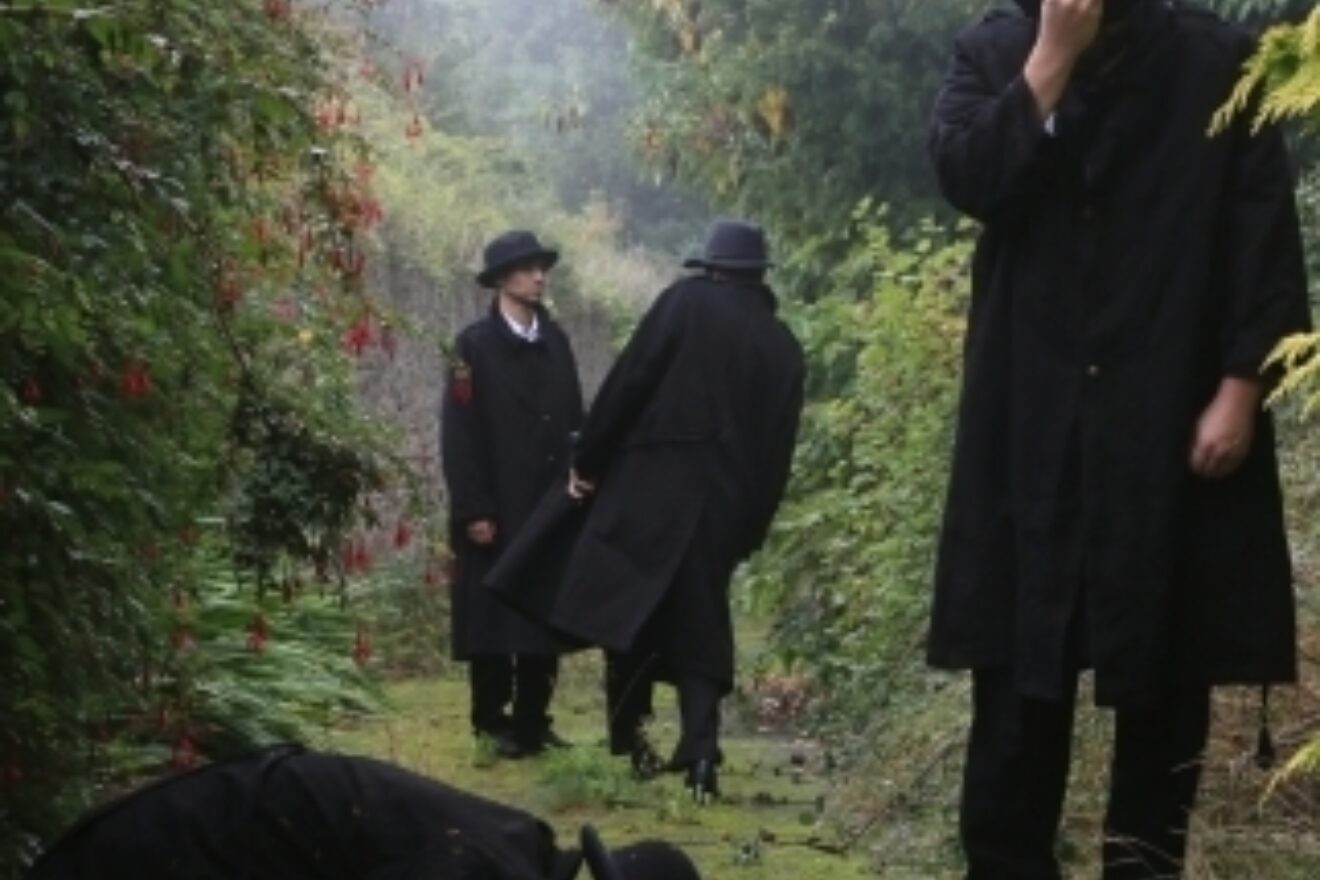
Other references to the world of Beckett are less oblique. Following the Butoh overture, the three performers enter clad in trench coats, leather brogues and brimmed hats, garb that evokes the Chaplin-esque fool figures of Beckett’s universe, men who are clumsy and prone to pedantry in their actions. The way the performers move across the space echoes Beckett’s writing style too; they follow pathways criss-crossing back and forth, weaving in and out of each other in a pattern of increasing complexity. So too do Beckett’s words weave around themselves, manipulating the possibilities of grammar.
The set, designed by Oguri and Moses Hacmon, is ethereal and versatile, a crumpled swathe of white cloth that acts first as an eerie sea, before being hoisted to feature as a backdrop that the dancers alternately scamper behind and contemplate from the front. It’s a fitting representation of the void of bare consciousness that the characters in Malone Dies and The Unnamable inhabit.
Though these references to the trilogy can be spotted in the performance, ‘Return to Absence’ also extends beyond its starting point to less recongizably Beckettian habitats. The soundscape, arranged live by composer Paul Chavez and featuring the voices of Gavin Friday and Olwen Fouéré, shifts radically in tone as the piece progresses, ending in an unexpectedly sci-fi like realm where the sounds of whooshing light sabres provide the acoustic backdrop to Oguri, Barkan and Cochero’s grappling trio as they slide and slither across each other and the floor.
The performance closes out on a re-imagining of the pebble-sucking scene from Molloy. It’s a somewhat macabre ending, but with comedic edges. It’s also an appropriately de-contextualised event to conclude a performance that doesn’t seek to narrate, but rather to re-frame elements of a world written in words, through movement.